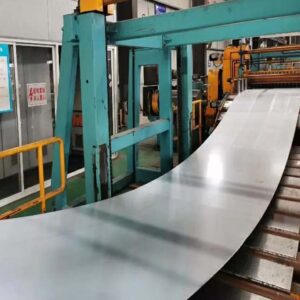
Galvanized Tinplate Food Grade


Galvanized Tinplate Food Grade
Tin-plated steel plate, commonly known as tinplate (SPTE), refers to a cold-rolled thin steel plate coated with a thin layer of metallic tin on the surface. It has certain strength and hardness, good formability and easy welding, the tin layer is non-toxic and tasteless, and the surface is bright. Tin mainly plays a role in preventing corrosion and rust. According to the production process, it is divided into hot-dip tinned steel plate and electro-tinned steel plate. Commonly used cans or beverage cans are made of tinplate.

[email protected]
Email:
+8613365312202
Whatsapp:
PRODUCT DESCRIPTION
Features and advantages of tin-plated steel sheets:
Tin-plated steel sheet is a steel product with a thin steel sheet that can be stamped as a substrate, tin-plated on its surface, and has multiple protective films (layers). It has the characteristics of corrosion resistance, non-toxic, odorless, glossy surface, light weight, high strength (compared to paper, wood, composite materials), easy to print, easy to weld and process, and strong adaptability to ambient temperature.
The main feature is that the tin plating layer has the duality of electrochemical cathodic and anodic protection, that is, the potential of the inner wall of the food can with a certain vacuum and a complex mixture (or weak acid solution) is lower than that of the base material iron. Tin is the anode, and its dissolution protects the iron. During the validity period of the food can, the dissolved amount of tin is basically harmless to the human body; while its outer wall is in the atmospheric solution, and the tin coating is in a state of cathodic protection, which has enough chemical Stability, which is unmatched by other can materials. Therefore, more than 70% of the total output of tinplate is used for food and beverage packaging. In addition, it is also used for packaging and raw materials in chemical, pharmaceutical, electromechanical, hardware, telecommunication and instrument industries.
| Material Grade | SPCC, MR |
| Temper(BA&CA) | T1,T2,T3,T4,T5,DR8,DR9 |
| Tin Coating | 1.1~11.2g/m2 |
| Thickness | 0.15~0.50mm(Tolerance: +/- 0.01 mm) |
| Width | 600~1050mm (Tolerance: 0~3mm) |
| Coil inside diameter | 420/508mm |
| Coil Weight | 1~5 MT |
| Surface Finish | Bright, Stone, Silver, Matte, Mirror, and Color printing |
| Type | Designation of Tin Coating |
| Equal Tin Coating | 1.4/1.42.2/2.22.8/2.85.6/5.68.4/8.411.2/11.2 |
| Different Tin Coating | 1.4/2.82.2/2.82.8/5.62.8/8.42.8/11.25.6/8.45.6/11.28.4/11.2 |
| MR | Base steel low in residual elements that has excellent corrosion resistance. It is widely used in general applications. |
| L | Base steel extremely low in residual elements such as Cu, Ni, Co, and Mo that has excellent corrosion resistance to certain types of food products. |
| D | Aluminum-killed base steel used in applications involving deep drawing or other types of severe forming that tend to give rise to Lueder’s lines. |
Production method of electroplated tin sheet steel:
There are two production methods of hot-dip and electroplating. The thickness of the tin plating layer of the hot-dip method is thick and uneven, and the thickness of the coating is difficult to control. The consumption of tin is large, the efficiency is low, and its application is limited, so it is gradually eliminated. The electroplating method uses an electroplating process to uniformly plate a tin film on the steel plate substrate. It has high productivity, low cost, thin and uniform coating, and can produce different coating thicknesses. It can also be single-sided or double-sided.
The electroplating methods mainly include alkaline electroplating, sulfate electroplating, halogen electroplating and borofluoric acid electroplating.
acid plating
Alkaline Plating
The alkaline electroplating method uses sodium stannate as the electrolyte, and the current density, production speed, and current efficiency it withstands are all low, but the corrosion is average, the process is old, and there are not many online productions at present.
Production process of tinplate
The tinplate is composed of five parts, from the inside to the outside are the steel substrate, the tin-iron alloy layer, the tin layer, the oxide film and the oil film.
The production process of tinplate mainly includes processes such as tinning, reflow, cathodic passivation and oiling. The process of electroplating tin deposits a layer of metal tin on the cold-rolled plate. The reflow process makes a thin layer of tin-iron alloy layer between the cold-rolled substrate and the pure tin layer. The cathodic passivation treatment and oiling process respectively form a passive film and oil film.
Classification of tinplate:
1. Equal-thickness tinplate: cold-rolled electro-tinplate with the same amount of tin on both sides.
2. Different thickness tin plate: cold-rolled electro-tin plate with different tin plating amount on both sides.
3. First-class tinplate: electroplated tinplate that has undergone online inspection is suitable for conventional painting and printing on the entire steel plate surface under normal storage conditions, and must not have the following defects: ① pinholes that penetrate the thickness of the steel plate; ②The deviation of the thickness beyond the standard; ③Surface defects such as scars, pits, wrinkles, and rust that affect the use; ④Shape defects that affect the use.
4. Second-level tinplate: the surface quality is lower than that of the first-level tinplate. It is allowed to have small obvious surface defects or shape defects such as inclusions, wrinkles, scratches, oil stains, indentations, burrs, and burning spots. It is guaranteed that the whole steel plate can be painted and printed normally.

Packing and shipping
The company has domestic first-class professional technical consultants and a team of outstanding employees with professional skills. The main products are carbon steel/galvanized steel. Stainless steel/steel coil steel bars, galvalume, color-coated coils, profiles, steel bars, aluminum products, roof panels. Products are sold to more than 60 countries and regions in Europe, the Middle East, Southeast Asia, and Australia.
FACTORY APPEARANCE
Company As 20000 Square Meters Of Indoor Storage more Than 20,000 Tons Of Inventory, Spot Product Standard Involves European Standard American Standard British Standard Australian Standard German Standard, Now According To Customer Requirements For Product Opening Strip.Cutting.Processing.Annual sales of more than 60 milliontons.Our company owns the firs class professional technique adviser in China and the excellent staffs with professional technology.The main products are carbon steel / galvanized.

PRODUCT DESCRIPTION
We promise”complete specifications, prompt delivery, high quality, competitive price, “The unwavering supports you provide, along with the increasing requirements you put contributes to more varied high-quality products with more competitive prices we offer.Win-win situations are always our pursuit.

OUR ADVANTAGE
We have won recognition from our clients due to our good creditand good services.